
Outstanding Warrants in Mills County
Mills County publishes no full active-warrant search. The Sheriff's Most Wanted page is a selected public notice, not a complete roster, and the county Tyler portal searches court and citation records without any active-warrant filter. For a current answer, go to the court named in the case. A county citation points to Justice Court or the city court printed on it. A county criminal matter belongs with County Court and its clerk, while a district criminal record goes to the 35th District Court and the District Clerk. The sheriff's public number can route a law-enforcement question, but it is not a warrant status line. In Mills County, the court clerk is the reliable route for warrant status on a named case.
No Mills County Active Warrant Database
No full warrant list means you ask directly, not that you guess. The Mills County sheriff site offers a curated notice page and a general contact channel, but no dedicated warrant unit phone, roster download, jail lookup, or update schedule. A public page can also omit sealed, unserved, or investigative records. The command-staff directory helps with agency routing. It is not an active warrant query. For personal status, call the issuing court or have counsel contact it. The official Mills County Sheriff command-staff directory shows the agency's public contact route.
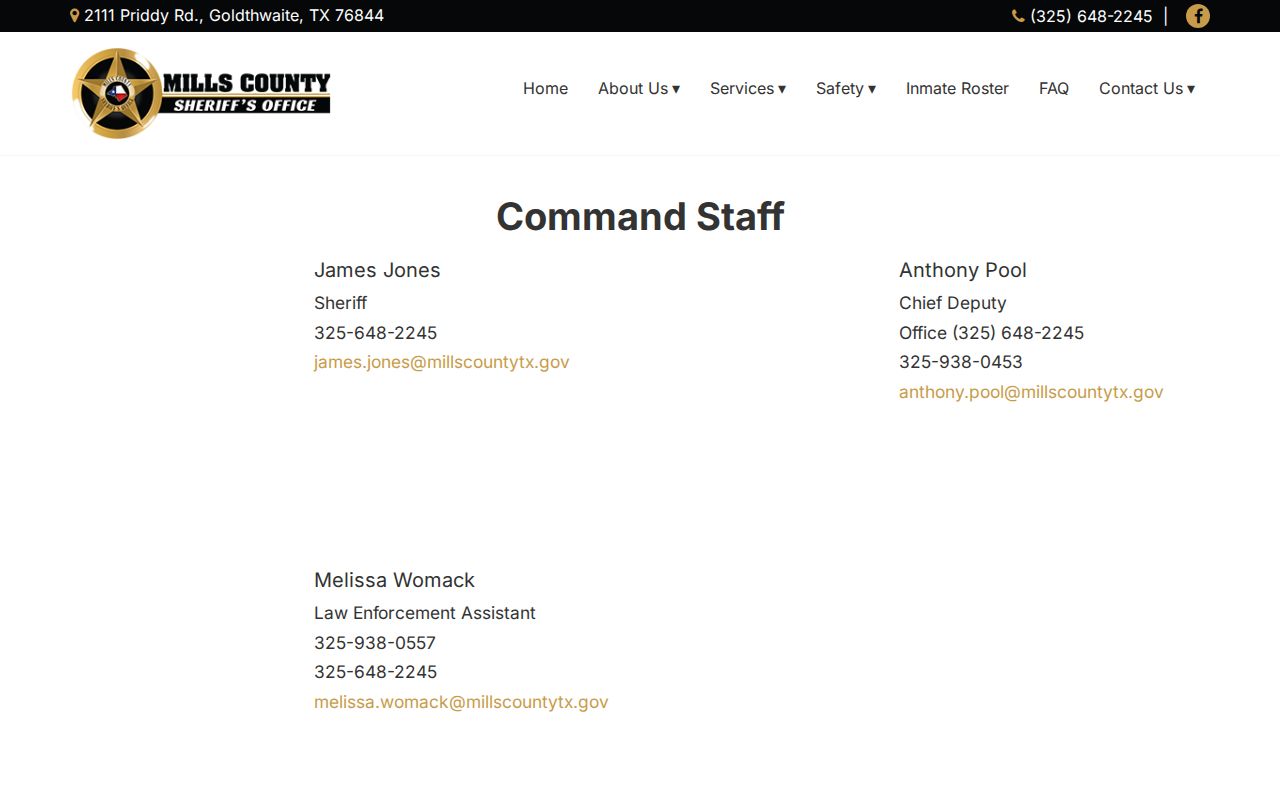
The directory identifies sheriff leadership and general agency contact details, not a warrant desk.
How Mills County Tracks Active Warrants
Each Mills County court creates its own warrants and records its own case events, and officers return service information to that court. The public pages describe no shared county system that rolls every warrant into one live index. The sheriff's notice page carries no last-updated date or complete-list statement. Office hours differ too: the District Clerk posts hours unlike Justice Court hours, and the County Clerk offers yet another court-record route. Contact the office that holds the case rather than treating the courthouse as one counter. The Sheriff's official site gives agency and public contact information.

The sheriff serves and routes law-enforcement matters. Court status still comes from the court.
Read the Mills County Notice as Selected
The Mills County Sheriff's Most Wanted page looks like a roster, but the site never says how often it refreshes or whether it covers every active warrant. No warrant number, issuing court, bond amount, or status date appears on it. Read it as a public notice channel only. Open the official Most Wanted page directly to see what it currently posts. If you spot a notice, use safe official contact channels. Never approach anyone on the list. The sheriff posts its mission and public-service routes separately from the selected names.
Active Warrants: What They Show
A court record can carry the cause number, court, process type, offense or judgment, issue date, return, bond notation, and any later recall or satisfaction. Mills County's public search pages show no complete warrant record sample. Ask the clerk for each field you need to understand the current court action.
| Cause number | Not shown in a public sample Request the court’s identifier. |
|---|---|
| Process type | Ask whether the record says arrest warrant, FTA, capias, or capias pro fine. |
| Status date | Ask when the court last recorded service, recall, or return. |
| Bond | No current county schedule or accepted method was found online. |
| Issuing office | Names the judge or court with authority over next steps. |
Mills County Tyler Shows Cases, Not Status
The Mills County Tyler portal searches case and citation data by case number, name and date of birth, driver license, vehicle, or business. Its landing screen has no active-warrant filter, bond field, or recall control. It can help you find the file that points to the right court. It cannot prove a warrant is open. Ask the court to confirm the exact instrument and current status date. If a case shows a balance, ask whether the court issued a separate capias pro fine or FTA process. Paying and recall are two different questions in Mills County, and only the court can answer both.
Mills County Warrant Roundups
No Mills County office runs an amnesty event, warrant roundup, fee waiver period, or special clearing campaign. An announcement from another Texas county does not apply here, and the sheriff's Most Wanted page is not a roundup notice. What does exist are the regular Chapter 45A recall and hardship procedures in justice and municipal courts. Those are everyday court rules, not an amnesty. With an old citation or a missed setting, ask the issuing court in Mills County which rule and local filing method applies.
Mills County Has No Current Warrant Count
Mills County publishes no current count of outstanding, bench, arrest, or capias pro fine warrants. The Goldthwaite OCA report is a historical aggregate built on a 2019 population figure, with no usable current warrant count. It cannot estimate what is active now. A short Most Wanted roster is not all warrants either. For one case, get a status confirmation from the court or clerk. For a general record copy, a narrow Texas Public Information Act request may work, though an exception can limit release.
Finding Your Own Name on the List
Write the court, the case number, and the exact status terms on paper. Call the issuing office first. A trip to the courthouse or the Mills County sheriff can wait until you know what you face. Ask whether it is an arrest warrant, a missed-appearance process, or a capias pro fine, and whether counsel can appear for you. Also ask what written proof follows a recall or a new setting, since no walk-in surrender or bond-window schedule is published.
Use the court’s instructions. Do not treat a missing list entry, a portal balance, or a payment receipt as proof that the process is resolved.
If the name belongs to a relative, let that person or their lawyer speak with the Mills County court when required. Skip sending full personal identifiers through a general form.
Verify Mills County Status With the Court
Ask the court for the current status date, the court name, the instrument type, and the next step required of you. In Mills County, the Justice Court, County Court, municipal court, and District Court each control their own dockets. The sheriff handles custody routing and public-safety questions only. A Texas PIA request can produce a record, but it is not same-day warrant clearance. For court records, the District Clerk points to re:SearchTX. An FTA or failure-to-pay license renewal hold runs through DPS and OmniBase, which track reporting and compliance rather than outstanding arrest warrants. Have the reporting court confirm both issues.