
Mills County Warrant Checks
Sorting out the case type saves time on any Mills County warrant check. Was it a citation or a fine-only matter? Those usually sit with the county Justice Court or a city court. County criminal files run through the County Clerk and County Court, while district criminal matters belong to the District Clerk and 35th District Court. The sheriff’s main line can point you to the right agency. Just remember it is not a verified warrant-status line, so the court of record remains the place to confirm.
- Write down the court, case or citation number, and the date shown on any notice.
- Use the county Tyler case portal to locate an underlying citation or case, not to assume warrant status.
- Call the issuing court or clerk and ask for the exact process and current status date.
- If the court is unclear, ask the sheriff’s office or courthouse to route the question.
- For a copy, send a narrow public-information request. For next steps, ask counsel and the issuing court.
Mills County Has No Full Warrant Search
Mills County publishes no complete, searchable active-warrant database. What it does offer is narrower. The Sheriff runs a selected Most Wanted page, and the county Tyler portal searches case and citation information. Neither is a full warrant index, so a status question still goes to the issuing court. The sheriff’s message page offers a public contact route plus current agency information, though it does not create a warrant unit, an after-hours desk, or a walk-in surrender counter. Ask for routing there, then verify the case with the court itself. You can read the Mills County Sheriff’s official message for its public contact details.
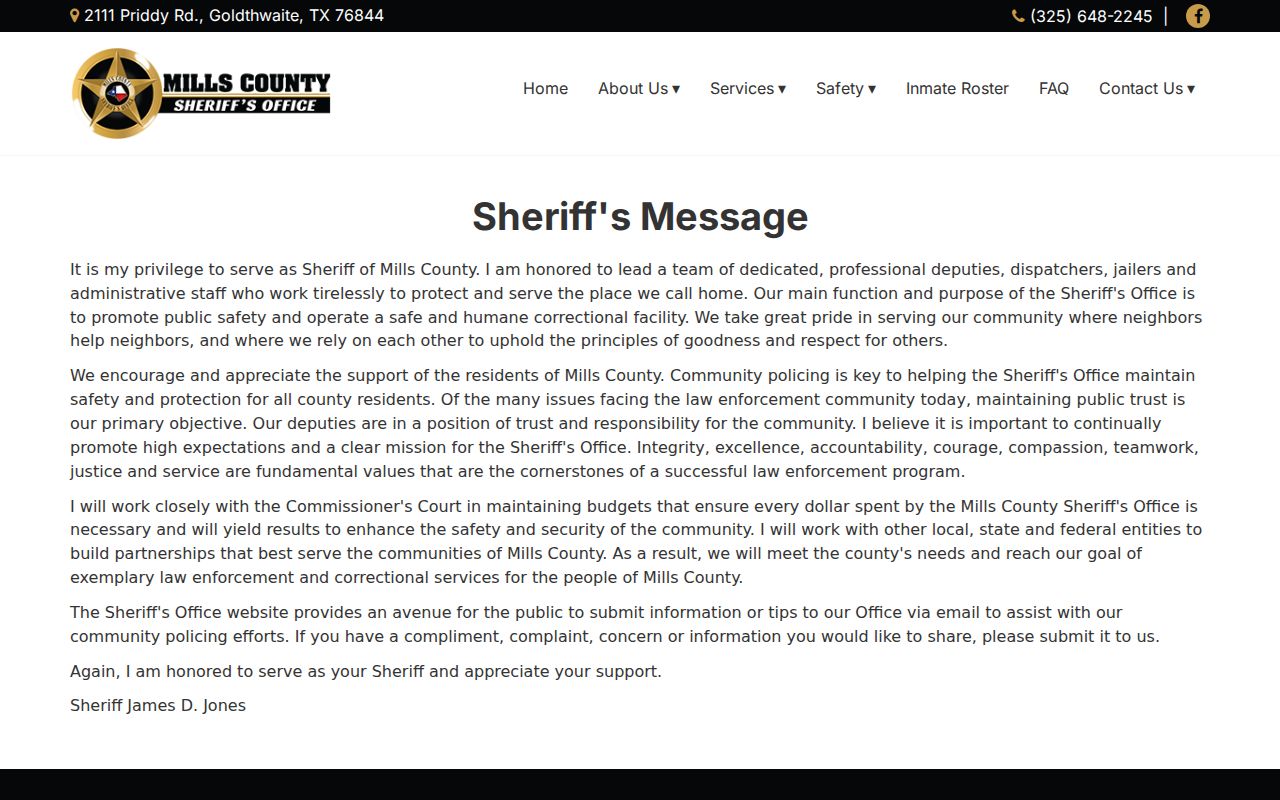
The page points you to the Mills County sheriff’s public channel. It cannot replace the issuing court’s own status record.
Warrants in Mills County: The Main Types
The word warrant covers several different legal tools. A search warrant only authorizes a search, and it says nothing about an arrest warrant. Miss a court appearance? For an unpaid Class C judgment, a Mills County Justice or municipal court may issue FTA process or a capias pro fine. Ask the court which instrument appears in your case, since the label shapes what happens next.
| Process | How It Arises | Likely Local Source |
|---|---|---|
| Arrest warrant | Magistrate issues process after the legal showing required by Texas law. | Issuing court; peace officer may serve it. |
| Bench or FTA warrant | Court action after a missed required appearance. | Justice, municipal, County, or District Court by case. |
| Capias pro fine | Justice or municipal judgment remains unsatisfied. | Court that entered the judgment. |
| Search warrant | Authorizes a search under its terms. | Issuing magistrate and serving officer. |
Mills County Tyler Portal Case Options
The county’s Tyler/Municipal Online Services portal gives a few ways to track down an underlying case in Mills County. That helps if you hold a citation or need to identify the court file. What the landing page lacks is a warrant-status field. There is no active or inactive filter, no bond field, and no recall control. You may also hit sign-in controls and an identity-service notice. Use only the identifier a search truly needs. A business-name result is not a personal warrant answer, and a sensitive number you type for a search should never get copied into a message or shared example.
| Visible Search | Inputs | Limit |
|---|---|---|
| Case or cause | Case/cause number | Finds a case, not a warrant guarantee. |
| Name | First name, last name, date of birth | No public result sample or warrant filter was shown. |
| Driver license | Number, state, date of birth | Keep these private; they are not needed for a general example. |
| Vehicle or business | Plate and state, or business name | Portal options do not define warrant coverage. |
The county case and citation search is an official route to the interface.
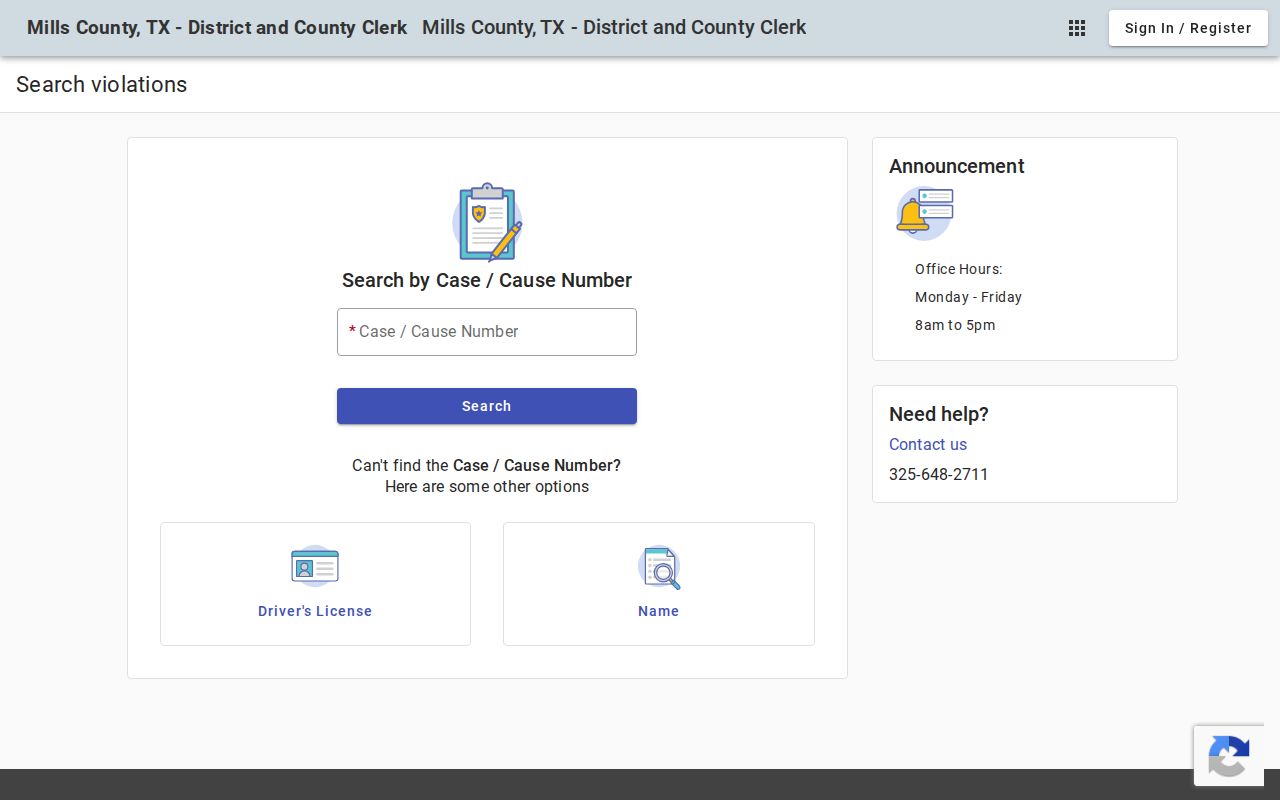
Treat the Mills County search labels as case-finding tools. Only the court can say what a matched result means for a warrant.
Mills County Warrant Records: What They Show
A court or law-enforcement record can carry a cause number, the instrument type, issuing court, offense, issue and return dates, serving agency, a bond notation, and any later recall or satisfaction. The exact fields vary by office. Mills County exposes no public warrant schema on the Tyler landing page, so expect differences from file to file.
| Number | Not shown on search page Ask the court for the cause or process number. |
|---|---|
| Issuing court | Identifies the court or magistrate that controls the process. |
| Offense or judgment | May identify the charge, citation, or fine tied to the case. |
| Return or status | Ask whether process is active, served, recalled, or reissued, and when that status was entered. |
| Bond | No Mills warrant bond schedule or accepted method was located. |
A Mills County PIA Request Is Not a Status Check
Mills County’s Public Information Act form requests a defined record, nothing more. It collects the requester’s contact details, a clear description of the record, an optional date range, and delivery choices. A sheriff form asks for incident details and whether you want copies or inspection. Neither form works as a warrant-clearance or surrender application. Describe the court, record type, known case number, and date range, and ask which office holds the file if the sheriff is not the right source. Texas Government Code Chapter 552 opens public records to you while still shielding confidential and certain law-enforcement material. Read the county public-information instructions before sending anything. Even then, the form may draw a clarification question. It promises no release of a live warrant file.
Mills County Warrants: Who Issues, Who Serves
Location matters in Mills County. The courthouse at 1011 4th Street in Goldthwaite houses county offices and the Justice Court, while the sheriff’s headquarters sit at a different address on Priddy Road. A court issues process and keeps the case file. A sheriff or another authorized peace officer may then execute it. The jobs connect, but no single office answers every status and record question. The county’s contact map lists the clerk, Justice Court, County Judge, and sheriff phone routes, so check the official Mills County contact directory before calling. The Justice Court and Clerk pages post different Friday hours, which is worth a quick look.
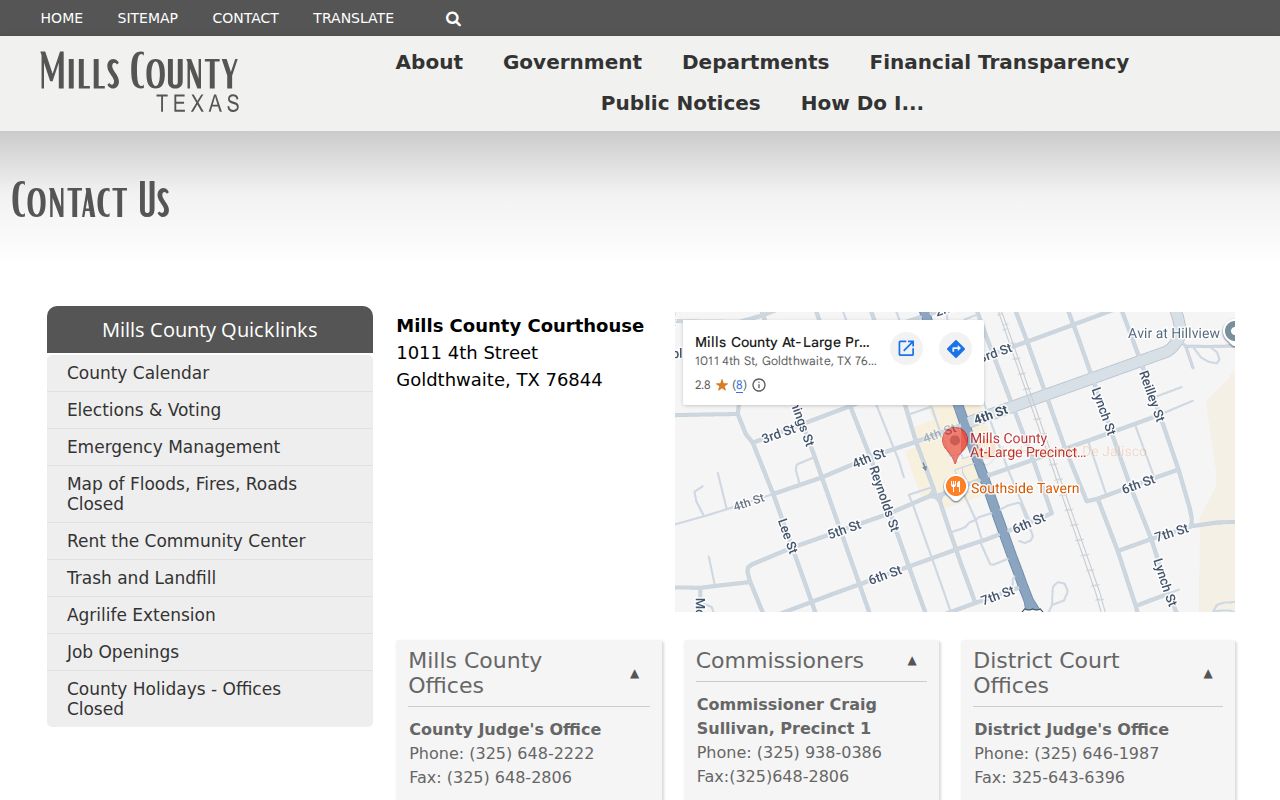
Match the call to the office role. Mills County’s courthouse and sheriff are not one warrant counter.
Mills County’s 1888 Sheriff History
Mills County’s sheriff history is a local story worth knowing. The first elected sheriff, G.W. Cunningham, served in 1888, when the first jail stood on the southeast corner of Courthouse Square. The sheriff lived below while inmates were housed upstairs. Today the office’s contact pages route people to a separate headquarters and the county courthouse offices. History gives context, not a current warrant count. Mills County posts no official public total for active, bench, arrest, or capias pro fine warrants, and Goldthwaite and Mullin are the two Census-listed incorporated places, so city questions go to those courts where applicable. The county website provides Mills County office and courthouse information.

The official county site is the starting point for current court and clerk contacts.
Handling a Mills County Warrant
Once a Mills County court confirms process, ask what it requires before you show up or pay anything. An FTA in Justice or municipal court might mean notice, a new setting, or a recall request. Chapter 45A also allows an undue-hardship hearing. District and County Court criminal matters are different. Those call for a case-specific plan from counsel and the issuing court, since Mills County posts no walk-in surrender instructions, bond window, or local recall form.
Call first. Ask the issuing court about voluntary appearance, counsel, bond, recall, and written proof. Do not assume the sheriff’s office can clear a court order.
Texas OmniBase and Mills County Traffic Warrants
DPS runs a Failure to Appear/Failure to Pay program that can block driver-license renewal once a court reports an unpaid or unresolved matter. Treat it as a court-compliance route, not a public warrant database. DPS will send you back to the reporting court. Its license staff cannot tell you whether an arrest warrant exists. On a Justice Court citation in Mills County, ask the court directly whether it reported an FTA or unpaid judgment, whether a separate capias pro fine is out, and how each one gets cleared. The Justice Court sits at the courthouse; the sheriff handles public-safety routing. One caution: an online payment receipt or an OmniBase call is not proof that warrant process was recalled. For the procedures themselves, the Texas Chapter 45A text lays out justice and municipal court recall and hardship rules.
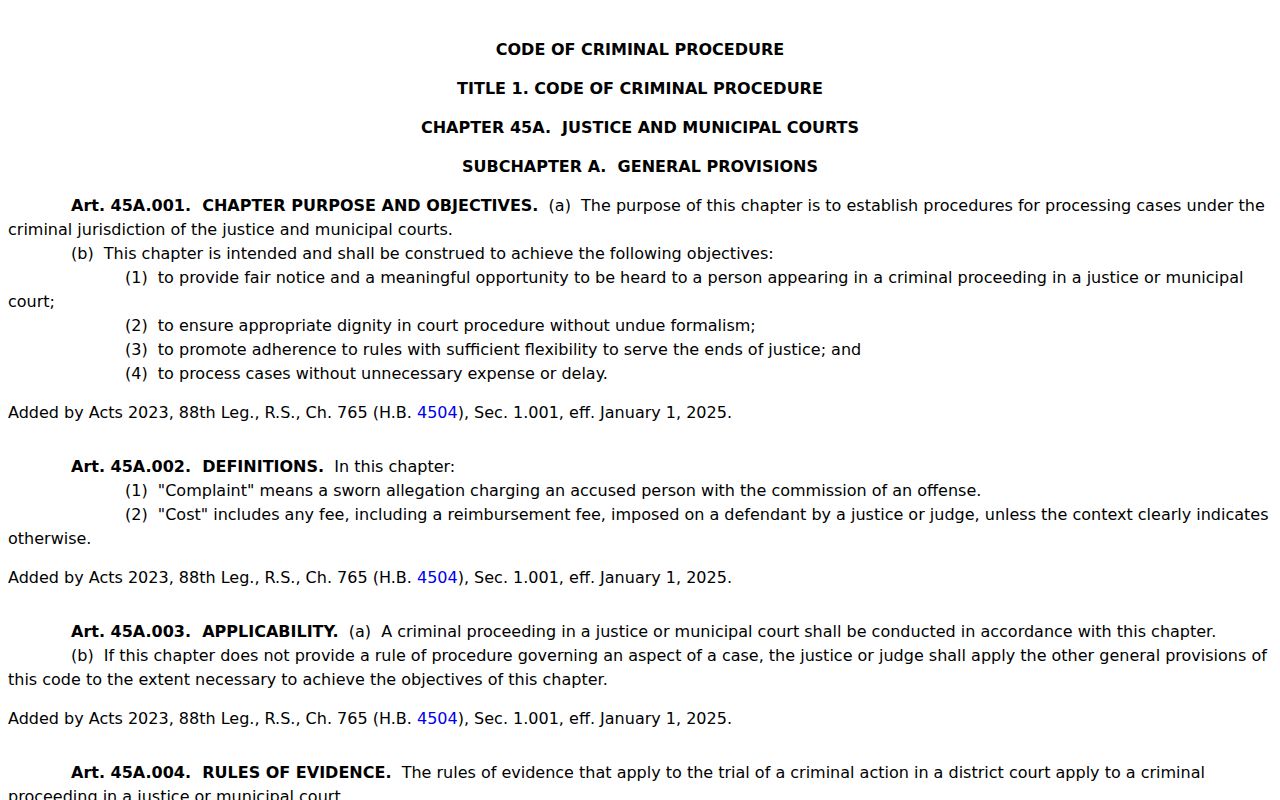
The statute sets the statewide rules for how these filings work, but the Mills County court still has to spell out its own appearance procedure.
Warrant Record Access Under Texas Law
The Texas Public Information Act covers many government records, but access still depends on the record and any exception. Juvenile information is restricted. Law-enforcement material may be withheld when release would interfere with an investigation. A public Most Wanted notice in Mills County is not a full court docket.
Access rules:
Government Code Chapter 552 sets the public-information framework and its exceptions.
Family Code Chapter 58 restricts juvenile-record disclosure.
Code of Criminal Procedure Chapter 15 covers arrest-warrant process.
Mills County Warrant Counts Stay Unposted
No office publishes a current countywide active-warrant total for Mills County. The OCA municipal report has a historical Goldthwaite row, nothing more. Census counts describe population, not court caseload. The sheriff's Most Wanted page is a selected list, and the Tyler landing page has no visible warrant-status control, so none of them supports a total. For a personal status question, call the issuing court. For general routing, the sheriff's main office is at 325-648-2245. For the full statewide court-record route, the District Clerk links re:SearchTX, though its coverage is not a single statewide warrant search. Open the District Clerk's current record links before searching district matters.
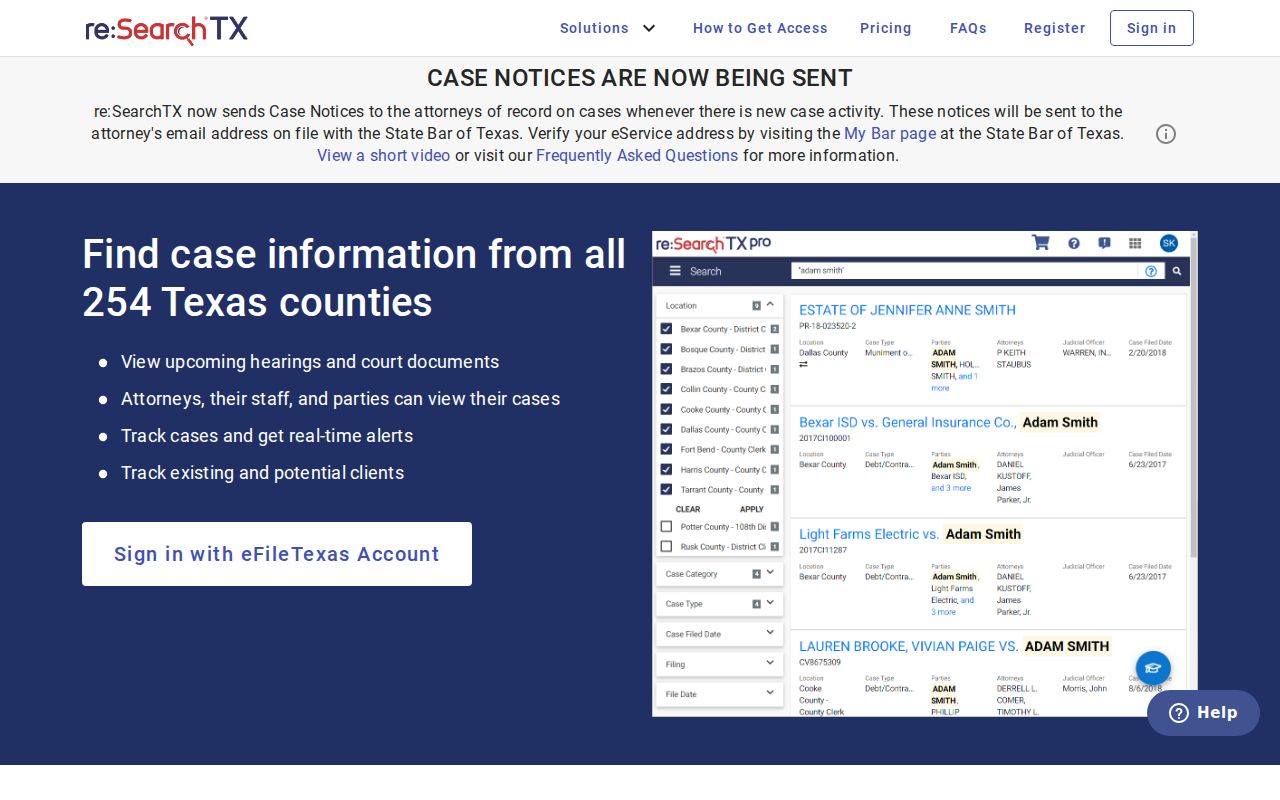
Use the state court search to locate case records where covered, and confirm any Mills County warrant with the issuing local court.
City Warrant Records in Mills County
The Census table lists Goldthwaite and Mullin as the incorporated places in Mills County. Goldthwaite has an official city website, but it publishes no warrant portal and no current municipal-court contact. Mullin has no official city website or court page. Route a city citation to its issuing court before treating county records as a substitute.
Goldthwaite Warrants
2020 Census population: 1,738. City website and City Secretary route; no warrant portal found.
Mullin Warrants
2020 Census population: 130. No official city website or warrant portal located.
Mills County Most Wanted Notices
The Sheriff's Most Wanted page works as a selected public notice channel, nothing broader. Mills County publishes no complete-list statement, no refresh schedule, and no countywide warrant total beside it. A short roster cannot tell you how many warrants are active, whether a named person is still wanted, or which court controls a case. For the current public notice, use the official Mills County Sheriff Most Wanted page directly. Checking your own status means calling the issuing court. Reporting a safety tip goes through the Sheriff's official channel, and never approach anyone named in a notice.